2024 Oration: Defending Australia’s democracy against global challenges
Barrie Cassidy
Tuesday 22 October 2024
In partnership with the Museum of Australian Democracy at Old Parliament House, Canberra
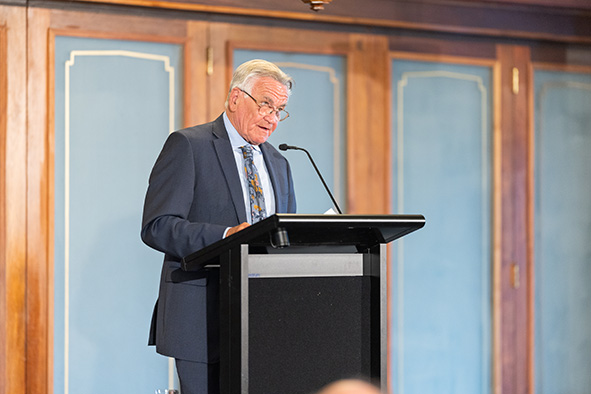
Barrie Cassidy, eminent political correspondent and Chair of the Old Parliament House Board, offers a report card on democracy here and around the world.
In short: grim in many places overseas and getting worse; yet much to be encouraged about here and much to watch out for.

Watch
Read transcript
Henry Parkes was the standout character in Australia’s 19th century pre-Federation political history. No matter that he died five years before Federation, his work had been done. He’d been pushing to unite the colonies for 30 years before that. His work did culminate, as Ian mentioned, in the famous Tenterfield speech of 1889. That then led to a federal conference in 1890 and a constitutional convention in 1891.
Now that’s not a bad template: the vision, the conference, a convention, and then a result. It’s a template we could think about in the modern day.
He was a remarkable character. He wasn’t educated or skilled in the traditional sense, and he certainly wasn’t a rich person. But he succeeded as a journalist and editor. He was a keen poet and an impressive orator. He had a powerful personality and a real knack for politics, so much so that he was the longest-serving premier in New South Wales’ colonial period.
Such was his political antenna that: what did he do to promote the concept of federation when he visited Victoria in 1893? He jumped in a carriage and he went to the Victoria Derby at Flemington and that’s the way politicians do it to this day in Melbourne.
I think the great legacy is how seamless and peaceful was the transition to federation. He helped create a new and quite a dramatic political order but embedded in strong democratic principles that have endured to this day. Principles effectively put together in just six weeks and yet so much of it met the test of time. It might have been the journalist in him but it was quite remarkable that unlike countries like Canada and the United States he insisted that the media be allowed into the conventions ensuring transparency and I think that undoubtedly led to a better result.
Some of his newspaper articles were informative in that respect. Consider he was a Premier and a politician himself, but he wrote this about the media’s obligation: calling on journalists to expose government corruption where it exists, he said their duty was to “make the voice of complaint, in such case, loud and general, till the cause be removed,” and “we shall put away all fear and affection in the performance of it.”[1]
How relevant to today: an appeal to the media to be fearless and courageous and not to let affections and familiarities hold you back.
That is sometimes difficult. Hidden in his columns too was some advice about how to handle constitutional change – change of any kind really. His message was really: don’t rush it; prepare the soil.
Two decades out from Federation he noticed a slowing in the momentum. And he wrote, “Maybe it is best to let the idea mature in men’s eyes, in men’s minds”. And it did, you know: 20 years later the nation was persuaded.
There was one area though, Ian, where I think you’d have to give him a fail. And that’s this. In 1849 he turned up at Circular Quay to demonstrate against the transportation of convicts. Now he was partly successful. The rates started to slow down. But the ships did arrive until 1868. And just as well, otherwise my family on both sides, the Cassidys and the Magans, would never have made it to Australia.
So now today I offer a report card on democracy here and around the world.
In short, grim in many places overseas and getting worse, yet much to be encouraged about here and much to watch out for. Thus the title of the oration: ‘Defending Australia’s democracy against global challenges’.
Because democracy is challenged everywhere, fragile almost everywhere; the world is in a democratic recession. The International Institute for Democracy based in Stockholm has quite alarmingly I think reported that last year marked the seventh year in a row in countries with a semblance of democracy where countries that went backwards, with a net decline, outnumbered those that advanced.
The Institute found that the decline reflected either flawed elections or attacks on freedom of expression or freedom of assembly. There are countries on the margins, countries struggling with cost of living and dealing with climate change and facing the reality of a tiny few growing obscenely rich, or of forced population movement and wars like the invasion of Ukraine.
So democracy is at its best stagnant in most places where it exists and declining in far too many other places. Autocracy, I think it’s fair to say – and world leaders have said this – is winning the fight against democracy.
The World Economic Forum now lists just 27 fully functioning democracies and that’s in a world of more than 200 sovereign nations. 27 countries where citizens are encouraged to vote – and that is important – countries which have broadly a free and independent judiciary and a free and independent media, the basic pillars of democracy.
Now at first blush you’d think 2024 has been a standout year for democracies. We were told at the beginning of the year, guess what, almost half the world – 4 billion people – are going to the polls, more than ever before. 49% of the world’s population, 80 countries. But don’t be misled by that. Just having an election and giving people a vote does not immediately translate to the best democratic values. It does not guarantee a full and fair election.
In Bangladesh for example – and I think that was the first election of the year – the Prime Minister won a fourth term, but there was no opposition. Because of persistent crackdowns on political dissent the major opposition party boycotted the poll.
In Pakistan the election went ahead with a former PM, the champion cricketer Imran Khan, in jail along with many of his supporters.
A Swedish think tank ranks on a scale of one to ten, countries and their ‘commitment to democracy’. They have countries like Syria, Chad, South Sudan rating a big factor zero; Bangladesh, Iran, Russia, not much higher.
Simply put: proper democracy demands proper elections and so much more than that.
So now we’ll go to the United States. We are about two weeks away from the election. And the situation there is chronic in many senses. It’s the biggest economy in the world, the one country that believes in its heart that they are the democracy standard bearer to the world; the country and its people that will profess a love for democracy without having any idea of how they have by their actions put all of that at risk.
It came to an astonishing flashpoint on 6 January 2021. A mob in support of Donald Trump, with so many convinced in their own minds that the election had been stolen from them, stormed the Congress. They attacked the Capitol building and it’s worth reminding yourselves of what the intention was. They wanted to prevent the Congress from counting the Electoral College votes and so deny Joe Biden victory.
It was by any interpretation an insurrection; people were killed, democracy denied, almost. And the former president was accused of either at best doing nothing to calm the mood of the mob or at worst actively encouraging them – and ever since he has praised the perpetrators as heroes who will be released from jail if he’s elected.
Who saw this coming? Who imagined growing up that something like that would happen in the United States in our lifetimes, and that more than half the elected Republicans to this day declined to disavow the notion that the election was stolen, and still many of them will not say in advance that they’ll necessarily accept the result of the next one.
This is despite the fact that nowhere has any governing authority, any campaign audit, any judiciary found any evidence of malpractice that might have impacted on the result. You can only imagine the impact that that’s having, more broadly, on the trust that people in the United States are placing in their democratic processes.
But it also points to just how deep was the resentment even before Trump gave voice to their frustrations and their prejudices. So many had lost faith in democracy already. They believe the system works against them and gives them no chance.
And in a country where most of the country’s wealth is in the hands of the top 5%, then that feeling of isolation and unfairness will fester. And when 70 million people, it seems, are rusted on to Trump, no matter what they might say in New York or Los Angeles, no matter what the courts find, then you get a sense of how deep that division is, and that surely will live on after Trump, even if he was to be defeated. He’s the standard bearer now, the lightning rod, but if he’s defeated, they won’t change. That deep resentment will stay with them. Nick Bryant, who is a former BBC foreign correspondent, and worked in the UK and the United States, and he’s now here, released a book called The Forever War: America’s Unending Conflict with Itself. And he argues that Trump is merely a symptom of a country with massive unresolved issues. The unending internal conflict over issues like race and immigration, wealth distribution, gun control, cities versus country, abortion rights – they just go on and on; they are deep -seated and historical.
And there’s also the question, even before Trump, even before 6 January 2021, of how democratic is the United States anyway? Look at the Constitution and how power is distributed at elections.
The House of Representatives is democratic by most standards. The vote for the presidency is starting to be questioned, with the Electoral College system seeming to reduce the contest to about six or seven battleground states, and what the rest of the country says won’t really matter.
But the real story is in the Senate, and the Senate is powerful. Each state has two senators, no matter the size of that state. So California, with a population of close to 40 million, has two senators. Wyoming, with half a million, has two senators. Now, if you apply the principle of one vote, one value, strictly speaking, if you’re going to give Wyoming two senators, you have to give California 160. They’re 80 times bigger, and they’ve got two. So is it any wonder that the Senate sometimes struggles, I think, to reflect the views of ordinary Americans? To put it another way, half the population of the United States is represented by 18 senators, and the other half by 82.
So increasingly, the Democrats are the party of the cities, and the Republicans are the party of the rest, and that’s hardly world standard. The system is such that I’ve seen opinion polls that go as high as 70% of Americans saying they would like urgent and drastic reform to gun laws. But they won’t get them, and that’s because far more than half the senators live away from the big population centers, and they don’t want changes. Neither do their constituents.
And there’s another aspect, I think, of their election that questions whether the United States is firmly and fully committed to democracy. President Obama pointed to it in a speech in 2016 when he said that the United States is a the only advanced democracy in the world that deliberately discourages people from voting. They vote on a working Tuesday. The lines are notoriously long – unlike the lines here at Old Parliament House, where you can walk straight in. And maybe even more worrying, they don’t have a central and a single electoral authority. The states have their own governing bodies. They set the rules, and even within the states, the rules can vary. Aall that leads to a lack of faith in the system
And they don’t have compulsory voting – I’ll come back to that.
Joe Biden has conceded that globally the argument for autocracies is growing. China for example finally embraced the open market but it resisted any movement towards democracy, a commitment to autocracy and communism as strong as ever.
They argue that under their system they were able to drag the nation out of poverty. Joe Biden had a telephone conversation with President Xi earlier on in his presidency. President Xi actually argued directly to the American president that democracy doesn’t work anymore. He said to him, democracy requires consensus and in a fast-moving world consensus takes too long. And that is their genuine belief, at least the belief of the leadership: that their system gets things done; no matter that the citizens have no basic rights. And this from a country that will soon be the biggest economic power in the world.
So how bad is it in the United States? Bad enough for the mainstream media to spend a lot of column inches raising the possibility of another civil war. Not a civil war like before, but maybe localised skirmishes – a sort of guerrilla tactic where people cause trouble, go on the attack and then vanish back into the community. They might even target individuals and judges and journalists and media figures, or buildings like black churches and synagogues.
These scenarios have been discussed widely in the media. A YouGov poll two years ago reported that two out of five Americans believe something like that could happen in the next ten years.
Off the back of that, a congressman from Iowa, a Republican Congressman, Stephen King – a fitting name for a scary guy – said this: folks keep talking about a civil war, he said. Well, one side – my side, he said – have about eight trillion bullets; the other side doesn’t know which bathroom to use.
It’s rather chilling when you get that sort of a comment from an elected lawmaker.
But you’d imagine that if democracy is to decline even further in the United States it won’t be as dramatic as all that. There remains civil control of the military and that’s an enormous safeguard against extreme events. Though civil control of the military is now being questioned by Donald Trump himself: he’s talked about using the military to quash what he called the enemy within. And of course by that he means political enemies. And he also talked of considering using the military, deploying the military, against the ‘lunatic left’ on election day. He’s got no right to do that, but apart from that he interprets who the lunatic left are. And you really want to be open to that interpretation.
So now to Australia and how we are holding up here. We’re not the United States, but Australia nevertheless has its challenges. There are pressure points here and some of them are quite concerning.
The federal government has set up an organisation across several departments called the Strengthening Democracy Task Force. And at one of their meetings they asked one of the contributors from the United States from Stanford University, Professor Larry Diamond, to have a look at the Australian situation and come back and address them.
And he did that. This is how you should look at it here in Australia, he said. Just consider that you’ve been to the GP and you’ve had a checkup and the GP says you’re in good, even robust health. However, there are some nasty viruses going around – misinformation, disinformation, polarisation – particularly in the media. There’s a degree of distrust of politicians and the political process. And there’s a powerful new transmission: social media and digital platforms. And that is going to test our immunity. We will need new remedies and new vaccines.
Here in Australia though we do have important guardrails. Bruce Warby, a senior fellow at the US Studies Centre, outlines the major ones in his book. We have a single authority that oversees all elections with consistent rules and regulations: the Australian Electoral Commission (AEC). There’s a survey that is carried out every year within all the Commonwealth departments and agencies, a trust survey; a thousand people voted and the AEC came out on top, as the most trusted government organisation in the country. 91% express satisfaction with their services.
During the Voice referendum, the AEC came under attack – wrongly accused of changing the voting rules to favour the ‘yes’ vote. They did not, not in any way. But it was a deeply disturbing development and you don’t like to see those kind of attacks on institutions, particularly those that we should be most proud of.
I voted in Richmond in Victoria and – I’ve never seen this before – there was a guy there handing out pens, telling people to use a pen, use one of these pens, because if you use the pencil they’ll just scrub it out; they’ll erase it and they’ll alter your vote. And I just looked at the guy – what do you say?
A second guardrail is compulsory voting as I mentioned before. Often when I raise this it sets off quite a debate, a lot of people don’t support it for various reasons, but in my view compulsory voting encourages people to engage at least once in the cycle. It surely encourages a lot of normally disengaged people to at least embrace some knowledge, some sense of how they will vote and why their vote matters. It’s more than a right. It should be seen, I think, as a civic duty.
As a result, we get a participation rate in the mid to high 90s. In the United States they struggle to get far above the half the population. I think in the UK recently it was 60%. It means that in the United States you can have just a little more than 25% of the population putting an individual in the White House. And you can see why Trump can emerge when he can count on 60 to 70 million rusted-on supporters no matter what.
A third guardrail is the political structure itself – the fact that basic government ministries emerge from the elected pool, and because they are elected they are then accountable to the people.
We still, though, have to do more to start restoring faith in democracy. A government -sponsored survey released earlier this year showed that 95% of Australians agree democracy is important, but only 59% agree democracy in Australia is working as it should.
So there is some disillusionment. But it’s not just the political process that disturbs people. The public service has let us down, in some respects, in recent times – too willing to do the work of the government without question.
The media also has a role to play, and is not playing it in so many respects. The mainstream media these days is under extreme cost pressures. They’re struggling with reach and relevance in the digital age. They downsize, they polarise to embrace a niche market. That’s the business model. They try and do more with fewer journalists, and as a result you get fewer critical eyes, fewer people gathering the information, and yet, paradoxically, you get more people using that limited information to opine and comment.
Social media, used properly, is a fantastic resource, but it can also be toxic and adversarial. It’s the antithesis to harmony and social cohesion. It fosters obsession with clicks and ratings ahead of a sober sharing of information. Social media, quite frankly, is where nuance and content and depth goes to die. Of course, it is so vulnerable to the worst disinformation and misinformation. As I mentioned, the Strengthening Democracy Task Force is taking up the challenge.
Where I and Stephanie and others have responsibility, is as the board of Old Parliament House, which is now, of course, the Museum of Australian Democracy; we are very conscious of our role and our capabilities.
The Museum was set up to celebrate democracy and to educate Australians about democracy. Now it has an even wider task, and that is to sustain democracy. We have some wonderful hands-on exhibits, and we do what we can in terms of public awareness campaigns around events like referendums. But sustaining democracy is the core of what we do, and the key to it – the most important element – is education, specifically education of future generations.
We get 350,000 visitors a year, and run 1,400 guided tours, but I think the most important statistic is that we get 87,000 teachers and students through the building every year. We’d like to do more but there’s a long waiting list, and of course we reach so many more of them digitally right around the country.
We have to sustain democracy; we have to find the money and the resources to do it. We can’t have the next generation ignorant about what makes up the basic pillars of democracy. We don’t want them disinterested; they need to be exposed and they need to be inspired.
In his Gettysburg Address, Abraham Lincoln lauded government ‘of the people, by the people, for the people’. It’s not perfect. ‘No one pretends that democracy is perfect or all-wise,’ said Winston Churchill. ‘Indeed,’ he went on, ‘it has been said that democracy is the worst form of Government except for all those other forms that have been tried from time to time.…’
So, just in closing, Australia is at once vulnerable and yet well placed. Partly because we got the basics right – right from the start. But there are a lot of things that are not quite right. We must, for example, find ways, I think, to be more open to reform and change.
If we do, and we honestly and openly confront the pressure points and deal with them, and continue our best endeavours to take the next generation with us, then we can be the nation in a troubled and fractious world that sets the example, the best example of democracy anywhere.
Thank you.
[1] The Empire, 28 December 1850, page 2. https://trove.nla.gov.au/newspaper/article/60034825
 The Henry Parkes Foundation